

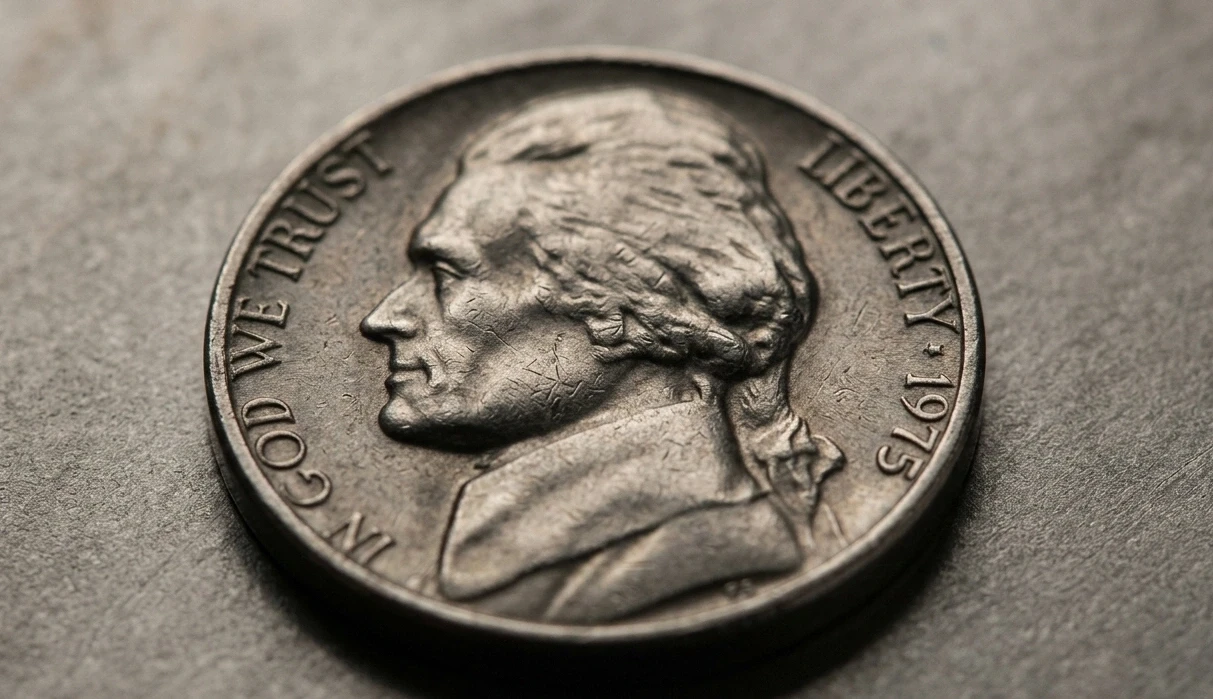
During 1975, United States mint facilities produced a massive volume of five-cent coins intended for daily commerce.
Usual market 1975 nickel value stays nominal, equaling exactly $0.05.
Situations change radically upon reaching the highest levels of the Sheldon scale.
| Parameter | Value |
| Composition | 75% Copper, 25% Nickel alloy |
| Mass | 5.00 grams |
| Diameter | 21.21 mm |
| Edge | Plain |
| Designer | Felix Schlag |
Mintage Distribution by Facility
Production facilities in 1975 operated at standard capacity, generating high volumes of inventory.
- Philadelphia (No Mint Mark): 181,772,000 units
- Denver (D Mark): 401,628,360 units
- San Francisco (S Mark, Proof): 2,845,450 units
Grading System and Surface Evaluation
Grading a coin determines its position within the price hierarchy, relying on physical surface conditions.
Circulated Condition
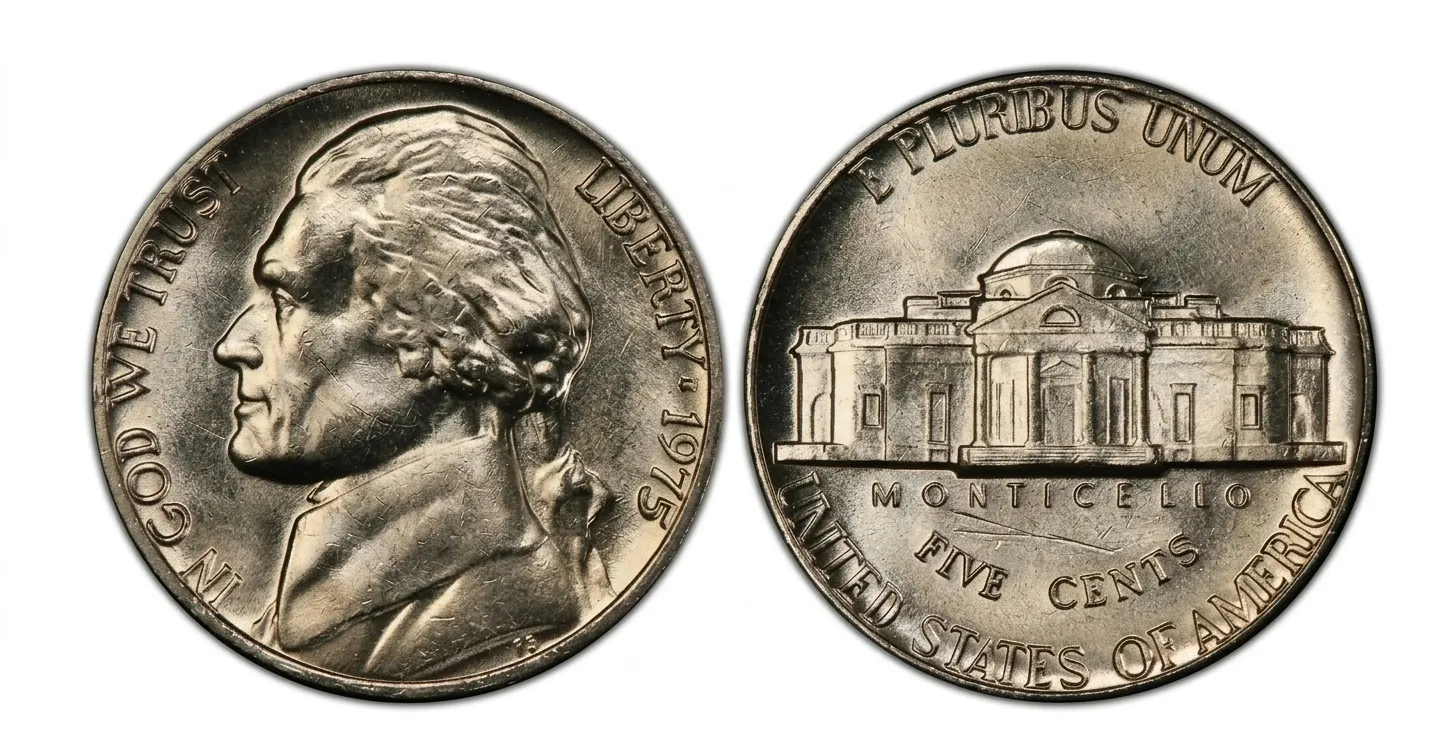
Surfaces characterized by scratches, rim dings, and heavy wear on high relief points define this grade. Jefferson’s hair and the columns of the Monticello estate blend into the coin’s fields. Value of such specimens → $0.05
About Uncirculated (AU50-AU58)
Light friction appearing on the portrait’s cheek and central columns indicates this level. Mint luster persists only in protected areas surrounding the lettering. Average price → $0.15 – $0.50
Mint State (MS60-MS64)
Coins never entering circulation retain their full original luster. Numerous small contact marks from bag storage frequently occur. Steps on the reverse remain poorly defined or interrupted by stray scratches. Value → $1.00 – $5.00
Gem Mint State (MS65 and Higher)
Minimal visual defects characterize these premium specimens. Strong, uniform luster covers the entire surface area. Exponential price growth initiates at this specific threshold.
1975 Philadelphia (No Mint Mark)
Philadelphia issues from 1975 demonstrate consistent demand among professional market participants in 2026.
| Grade | 2024 Price | 2025 Price | 2026 Price |
| MS63 | $2 | $2 | $3 |
| MS64 | $5 | $6 | $8 |
| MS65 | $15 | $18 | $22 |
| MS66 | $45 | $55 | $70 |
| MS67 | $420 | $480 | $550 |
Annual price changes for MS67 specimens average +14.5%. Auction records reached $1,265 for a single specimen graded MS67.
Full Steps (FS) Criterion and Capitalization
Determining Full Steps requires five or six clearly separated horizontal lines at the base of Monticello. Absence of any interruptions or hits across these lines remains a mandatory requirement for this status. Statistics reveal an extremely low survival rate for coins possessing such strike quality in 1975.
Reasons for FS rarity → Worn dies during mass production → Low striking pressure.
| Grade | Price (USD) | 5-Year Growth |
| MS64 FS | $45 | 12% |
| MS65 FS | $140 | 18% |
| MS66 FS | $850 | 25% |
| MS67 FS | $4,200 | 38% |
Denver Mint Analysis: 1975-D
Coins bearing the D mark appear twice as often as Philadelphia versions in average condition. Finding specimens lacking significant defects presents a major challenge despite the high mintage.
Factors influencing the Denver market:
- Large quantities of production errors
- Frequent erosion of working dies
- High concentration of micro-scratches on the portrait
| Condition | Value without FS | Value with FS |
| MS64 | $4 | $35 |
| MS65 | $12 | $110 |
| MS66 | $35 | $650 |
| MS67 | $280 | $3,800 |
Auction records for 1975-D MS67 FS stand at $4,560. Annual value increases for top-tier Denver grades remain within the 10-12% range.
Professional Certification and Authentication
Selling coins valued above $50 requires documented proof of the specific grade. Utilizing services from laboratories like PCGS or NGC minimizes buyer risks effectively.
Certification processes involve several distinct stages:
- Verifying metal authenticity
- Examining surfaces with the free coin value checker app
- Determining luster intensity and color saturation
- Assigning a numeric index based on the Sheldon scale
- Encapsulating the item in a tamper-proof plastic holder
Cleaning coins with chemicals or abrasives results in a 90% loss of numismatic value. Surfaces showing an unnatural mirror-like appearance despite worn details signal intervention. Such examples receive a “Details” label, excluding them from investment rankings.
Features of the 1975-S Proof Issue
Proof coins were manufactured exclusively for annual sets, never entering general circulation. Technology utilized polished blanks and double-striking to ensure perfection. This process produces mirrored fields and frosted relief.
Proof Quality Categories:
- Proof (PR/PF) — Standard polished strike
- Cameo — Noticeable contrast between fields and portrait
- Deep Cameo (DCAM) — Extremely strong visual contrast
| Grade | Standard | Cameo | Deep Cameo |
| PR67 | $3 | $5 | $12 |
| PR68 | $5 | $8 | $20 |
| PR69 | $8 | $15 | $45 |
| PR70 | $150 | $350 | $1,800 |
Perfect PR70 DCAM coins remain rare, representing less than 0.1% of the total verified population.
Comparison with Adjacent Mintage Years
Analyzing rarity within the context of the decade allows for accurate potential evaluation.
- 1974 Nickel → Higher mintage, lower average price in MS66
- 1975 Nickel → Moderate difficulty for FS hunters
- 1976 Nickel → Massive mintage, minimal price appreciation
Demand dynamics for 1975 show stability due to lack of sudden supply surges at major auctions. Consistent inflow of newly certified MS66 coins limits price growth in that segment, preventing it from exceeding inflation by more than 3%.
Identifying Manufacturing Errors
Coins possessing striking defects form a separate market niche. Their value depends on the type of error rather than the Sheldon scale grade, you can determine it with the free coin identifier app.
Common 1975 Error Types:
- Off-Center — Planchet alignment issues causing partial images.
- Double Struck — Repeated strikes hitting the same coin.
- Die Crack — Raised lines caused by broken striking tools.
- Clipped Planchet — Missing segments of the metal disk.
Off-center strikes of 10-20% carry values between $25 – $50. Errors exceeding 50% with a visible date increase prices to $150 – $300.
Collection Strategy Recommendations
Purchasing 1975 nickels in low grades serves no purpose for capital preservation. Optimal strategies involve acquiring specimens at MS65 or higher for both mints.
Evaluation sequences for buyers: Study date and mint mark → Check step definition → Verify lack of cleaning → Analyze luster.
Investment appeal for 1975-S Proofs stops at the PR69 grade, as supply meets demand entirely. Attention should focus on MS66 FS positions and higher tiers.
Known MS67 FS quantities for Philadelphia number only in the dozens. Such low populations guarantee price resilience during market fluctuations.